A Set-Up Field Is Not the Whole Village Game
Informal cricket can thrive without a formal ground. Learn how to set clear boundaries, choose suitable rules and make a shared local space playable.
The common mistake in informal cricket is treating every open patch as a miniature ground that must be prepared before anyone can play. That costs the group a chance to make a game from the spaces local players already share. A village game often begins with a different question: what kind of cricket fits here without getting in anyone’s way?
Choose the game first
Before judging the grass or laying out stumps, decide what the group wants from the gathering. A quick batting turn, gentle bowling practice and a full game with running place different demands on a space. Starting with the activity helps players avoid forcing a formal match onto a narrow or busy patch.
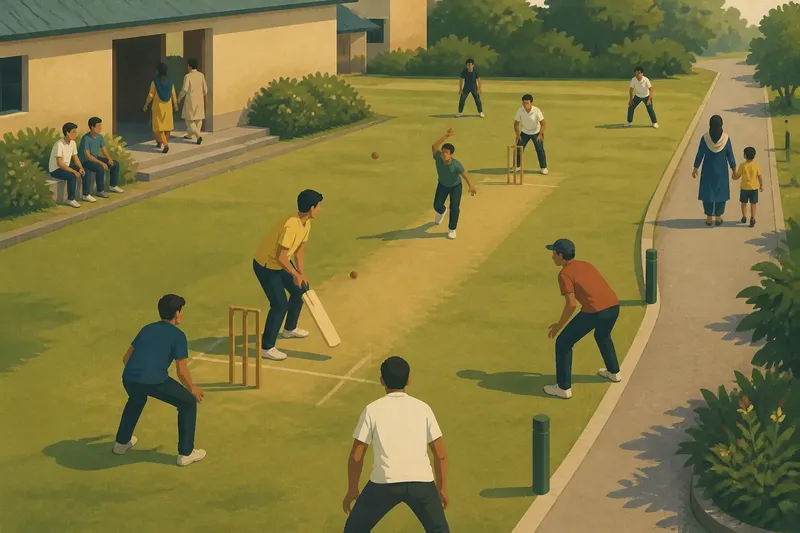
Say a group meets on an open strip beside a community hall, with a paved path along one side and shrubs at the far end. In this invented situation, the players have a bat, a soft practice ball and a few stumps. They choose a short, gentle game rather than a full match, leaving the path and hall entrance clear. The result is a smaller game shaped around the place, not a failed attempt to recreate a ground.
Start by asking what the space can comfortably host.
Map shared space
Walk the area together before deciding where the stumps go. Point out paths, entrances, garden edges and any place that other people need to reach. Players should be able to see the playing limits from the batting and fielding positions.
- Check whether a path crosses the proposed playing area; if it does, keep it outside the boundary and pause play for anyone passing, otherwise mark the boundary clearly.
- Check that hall doors and access routes stay open; if a player or ball could block them, move the stumps or choose another patch, otherwise leave the route unobstructed.
- Check whether shrubs, gardens or other fragile areas are within reach; if a ball could enter them, declare them out of bounds and agree that nobody retrieves a ball from there, otherwise set the boundary beyond them.
- Check the ground where players will run and bowl; if a spot is uneven or slippery, avoid it and choose a steadier area, otherwise use the space at a pace players are comfortable with.
- Check whether markers could create a trip hazard or disturb other users; if they could, use a safer visible marker or rely on agreed landmarks, otherwise place them where they will not obstruct anyone.
- Check whether people outside the game can pass without entering the playing area; if they cannot, shrink or relocate the game, otherwise agree to stop play whenever someone approaches.
Once everyone can identify the boundary, decide what happens when the ball crosses it. A rule is useful only if the whole group can remember and apply it.
Adapt play to place
A rough surface, limited room or nearby foot traffic can call for different cricket, not an argument about whether the patch counts. The group can choose a softer ball, bowl gently, shorten the running area or use a dead-ball call near a boundary. Agree on these changes before the first delivery so the same situation gets the same response.
Imagine the community-hall group sees that a fast shot could reach the path. They agree that a ball touching the path is dead, nobody runs while it is being retrieved, and the next delivery waits until the path is clear. They use the soft ball and bowl gently. The observable result is that players know when to stop and passersby retain a clear route.
Keep the adjustments simple enough to explain to someone arriving late.
Settle local calls
Small uncertainties can interrupt a friendly game: whether a ball in the shrubs is playable, whether a passerby stops the action, or how a run works in a compact area. Name likely trouble spots during the walk around the space, then agree on a clear call for each.
For example, a ball entering a restricted garden can end the play with no run, while a person approaching the hall entrance can prompt everyone to pause. In a narrow strip, players might count a run by reaching a visible marker and returning. These are local rules, so choose wording that everyone understands and apply it consistently.
If a call causes confusion, pause and settle it together before play resumes.
What fits this patch?
Does informal cricket need a level field?
No. A level surface can make cricket easier, but a smaller game may suit uneven ground. Choose a pace and style that the players find comfortable, and avoid areas that seem unsafe.
What should happen near a public path?
Keep the path outside the playing boundary and agree to pause whenever someone needs to pass. Decide in advance whether a ball reaching it is dead and who retrieves it.
How can a beginner join?
Explain the local calls before play and offer a role that feels manageable, such as fielding nearby or taking a gentle batting turn. Let the player ask for a slower pace, a different ball or a break.
When should players choose another space?
Move if other people cannot pass freely, the available area does not suit the ball or pace, or the group cannot agree on clear limits. Choosing a better-fitting activity or location is part of organizing local play.
Make room for local play
A set-up field is only one way to organize cricket. A short game beside a community hall, a few batting turns in a park or gentle practice on a village green can each take a different shape, depending on who shares the space and what the ground allows.
For local play, begin with the people and the place: choose an activity, mark what must stay clear, and agree on the calls that matter. That approach makes the phrase informal cricket mean more than a game without formal equipment; it means a game whose rules belong to the people playing and the surroundings they share.