Why the Boundary Takes the Shape of the Ground
Why the boundary takes the shape of the ground: understand how fences, slopes, access routes and usable space determine where the fielding limit sits.
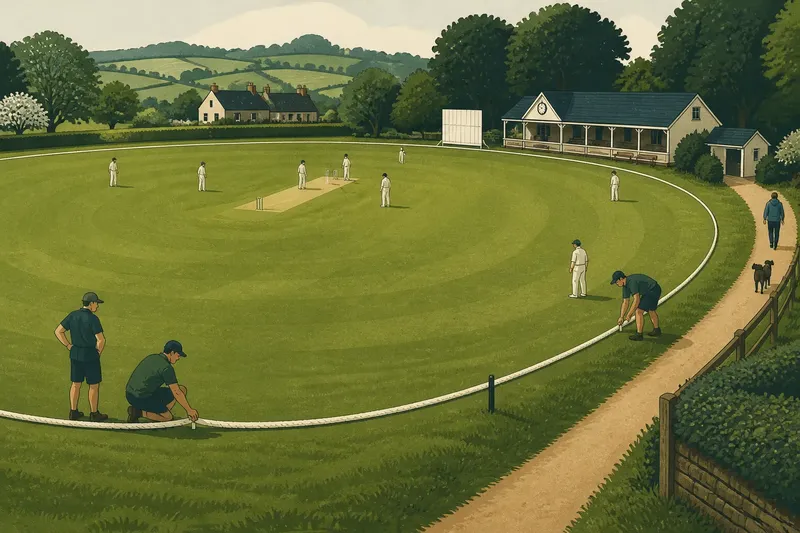
The common mistake is to assume a cricket boundary should form an even ring around the pitch. On many grounds, that assumption puts the rope across a path, too close to a fence or into a patch of ground that cannot be played safely. The boundary takes the shape of the ground because the playing area has to fit the space available, not an imagined circle.
Why isn’t the boundary an even ring?
A cricket boundary marks the limit of the playing area, not a fixed distance from the pitch in every direction. The pitch may sit centrally, but the usable ground around it can be uneven: one side may open onto a broad outfield while another meets a pavilion, trees, a road or a hard perimeter.
That makes a boundary an arrangement of practical limits. The rope, line or other agreed marker is placed where a ball can be fielded and retrieved without creating an obstruction or an avoidable hazard. The resulting outline can be oval, irregular, or noticeably closer to the pitch on one side.
Imagine a village ground with open grass beyond the leg side but a public footpath near the off side. The organizers might mark a generous arc across the open grass and bring the boundary inward beside the path, leaving a clear route outside play. The visible result is an uneven shape that fits the site better than a matching curve would.
How does the ground layout shape it?
Start with the fixed features that cannot simply be moved for a match. A pavilion, sight screen, fence, drainage channel, bank, tree line or neighboring playing area may limit where players can run and where a ball can travel. The boundary needs to account for both the playing surface and the space just beyond it, since a ball crossing the line may still need to be collected.
Access routes matter too. Grounds may have gates for players, grounds staff or spectators, along with paths used during the day. A boundary that blocks a gate can disrupt entry and retrieval; one that sends fielders across a busy route can create a more serious problem. Keeping an opening outside the playing limit can be part of the layout, not an afterthought.
The outfield’s contours influence the shape as well. A slope or hollow may make one area awkward to patrol, while a level strip beside the pitch can offer room for a fuller arc. A marker is most useful when it clearly separates the playing area from its surroundings and remains visible to players, officials and spectators.
Walk the perimeter before placing markers; a view from the pitch can hide a path or a low obstacle.
What counts as the boundary?
The boundary is the agreed limit of the playing area, identified by a boundary edge or by a marker such as a rope. The important point is that the marker has to define a line players and officials can recognize. A nearby hedge, fence or painted feature does not automatically become the boundary just because it looks like an edge to the ground.
Where a rope is used, its placement needs to make clear which side is in play and which side is out. If the rope bends around a structure or changes direction, those transitions should still be easy to judge. Loose sections, gaps and ambiguous corners invite disputes about whether a ball touched the boundary or crossed it.
Grounds may also use a painted line, cones or another visible marker where a rope is unsuitable. The chosen method should suit the surface and remain distinct from other markings. A line that disappears in the grass, or cones that can be shifted by routine traffic, can make the limit unclear as the match goes on.
For a formal match, the applicable playing conditions and competition arrangements determine how the boundary is identified and treated. Check those before marking the ground; an informal local arrangement should not be assumed to apply in every fixture.
How much room should be left?
There is no single layout that suits every ground. The available space, the level of play, the condition of the outfield and the presence of fixed obstacles all affect how far the boundary can sit from the pitch. A compact village ground may need a shorter limit than a spacious venue, while a temporary arrangement may differ from the ground’s usual setup.
What matters is a coherent, playable outline. Avoid pinching the boundary inward in one isolated spot simply to miss an obstacle if the result creates a narrow notch that is hard to judge. Instead, consider a smooth change in the line around the restricted area, while keeping enough clear space for fielders to move and for the marker to remain visible.
There also needs to be a practical margin outside the boundary for the rope, for players slowing down and for retrieving the ball. If the marker sits immediately against a wall or a busy walkway, a fielder may have nowhere to stop safely. The boundary should reflect not only where the ball is in play, but what happens when it is fielded near the edge.
Do not adjust a playing boundary to suit one batter’s hitting range. Its shape should follow the site and the match arrangement, not a preference for making one side easier or harder.
How can organizers mark it clearly?
Before a match, organizers can assess the ground with a straightforward walk-around and a view from the pitch. Agree on the intended outline, identify fixed obstacles, and check that the marker can be seen from the central playing area. If several people are placing it, one person should coordinate the line so separate sections do not meet at confusing angles.
- Check fences, walls, trees and other fixed features that limit movement.
- Locate gates, paths and access routes that must remain clear.
- Look for slopes, hollows, wet patches or rough ground near the proposed edge.
- Choose a marker that stands out against the grass and is suitable for the surface.
- Trace the full outline and inspect corners, joins and narrow sections for ambiguity.
- Walk the line from the pitch and from likely fielding positions to check visibility.
- Make sure the area outside the marker allows a fielder to slow down and retrieve the ball.
For example, imagine organizers find that a proposed rope would cross the entrance to the equipment shed. They could move the line inward around the entrance, then join it gradually back to the broader curve. The expected observable result is a clear opening for access and a boundary that remains understandable from the pitch, rather than a rope laid across a route people still need to use.
What should players check?
Players should know where the agreed boundary actually runs before play begins, especially if the outline is asymmetrical. A quick look from the pitch can show which side has a closer limit, where the line bends and whether a natural feature sits inside or outside the marked area.
Fielders benefit from noticing the ground beyond the marker as well. A slope, fence or pathway can affect how they approach a ball, even though it does not change the boundary itself. Knowing the edge helps a player judge where to slow down, while keeping attention on the ball and on nearby people.
If a marker shifts during play, raise the issue with the umpire or the person responsible for the match rather than quietly moving it to a preferred position. The aim is to restore the agreed line consistently and avoid competing interpretations.
What do players ask about the boundary?
Can a fence be the boundary?
It can serve as a physical edge if the match arrangement defines it that way, but a fence is not automatically the boundary. The agreed marker or applicable playing conditions establish the limit.
Can the boundary change around an obstacle?
Yes, the marked line can bend to fit a restricted part of the ground. The change should be clear, consistent and agreed before play rather than improvised after a ball reaches the area.
Does a shorter side change how a ball is judged?
The boundary’s location affects whether a ball reaches the limit, but the relevant match rules govern how that event is decided. Players should use the marked line and the umpire’s decision rather than estimate from the pitch.
Who decides where it goes?
The people organizing the match establish the setup, subject to the rules and playing conditions that apply to the fixture. If a competition provides specific requirements, those take precedence over a ground’s usual informal arrangement.
When you look at why the boundary takes the shape of the ground, the useful question is not whether the outline is perfectly even. Ask whether it is visible, consistent and suited to the obstacles, access and playing space around the pitch. A well-marked irregular edge can make the ground easier to use than a neat circle that ignores how the place actually works.